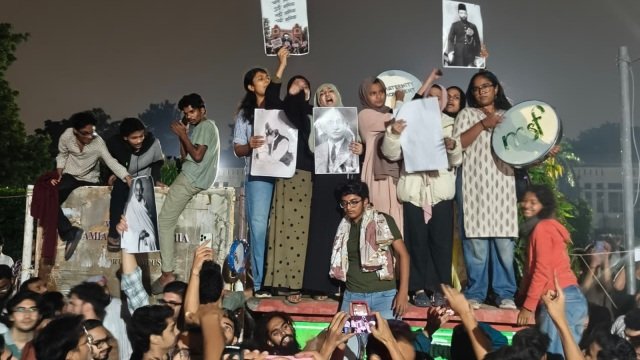
The ongoing student protest at Jamia Millia Islamia (JMI), New Delhi, has brought renewed attention to the Lyngdoh Committee report, a framework that continues to shape student union elections across Indian universities.
The report, submitted in May 2006 by a committee headed by former Chief Election Commissioner J.M. Lyngdoh, was commissioned following Supreme Court directions to address concerns about criminalisation, excessive election spending, candidate eligibility and disputes during campus polls. The Court accepted key recommendations in September 2006 as an interim measure.
At Jamia, where the students’ union has remained defunct since 2006, the report has become particularly relevant as students demand the restoration of an elected representative body. The university's administration has now set a timeline for the union's revival following weeks of protests and hunger strikes.
Why Was the Lyngdoh Committee Formed?
The committee was established to examine problems associated with student elections, including the influence of external political interests, the use of money to influence voters and disputes over candidate eligibility.
Its mandate was not to eliminate student politics but to create a framework for elections that were free, fair and conducted in a manner consistent with the academic environment of universities.
The report examined four principal areas: criminalisation in student elections, financial transparency and expenditure limits, eligibility criteria for candidates, and mechanisms for resolving election-related grievances.
It also considered how political divisions and indiscipline could affect campus life. The recommendations sought to protect students' ability to choose their representatives while reducing the scope for coercion, unfair practices and outside interference.
What Are the Committee's Key Recommendations?
The Lyngdoh Committee proposed several safeguards for student union elections.
- Fair and regular elections: Universities and colleges should ordinarily conduct elections for student representative bodies, following the prescribed framework or equivalent standards.
- Candidate eligibility: Rules govern factors such as age, academic performance, attendance and criminal records, subject to the applicable recommendations.
- Financial transparency: Candidates must follow expenditure limits and account for election-related spending.
- Grievance redressal: Institutions should provide mechanisms to address disputes over eligibility, procedure and election conduct.
- Safeguards against interference: The framework seeks to limit the harmful influence of external political interests and practices that undermine a fair campus environment.
The recommendations also recognise that where a campus environment makes peaceful and fair elections difficult, institutions may need an alternative system of student representation until conditions improve.
The central principle is that student representation should be meaningful, but the electoral process must also remain accountable and transparent.
Why Is the Report Important for Jamia?
Jamia's student union was dissolved in 2006, and elections have not been held since. The current agitation, which began on October 12, 2026, has centred on demands to restore the union and establish a definite timeline for elections.
On October 21, the university constituted a five-member committee to draft the union's constitution. The panel was asked to examine the circumstances surrounding the union's dissolution, relevant court rulings, the Lyngdoh Committee recommendations and the university's own statutes and ordinances.
The administration's initial response did not satisfy all protesters, who argued that the absence of firm deadlines left the election process uncertain.
On October 29, however, the university announced a clearer timeline: the students' union constitution is to be approved and implemented by May 15, 2027, with elections to be held within six weeks of the start of the next academic session. The university also directed that disciplinary actions, suspensions, rustications and campus restrictions linked to the protest be revoked.
The announcement marks a significant step towards restoring elected student representation, although the implementation of the timeline remains crucial.
Student Representation Versus Political Interference
The debate over the Lyngdoh Committee report reflects a broader question facing Indian universities: how can campuses encourage democratic participation without allowing elections to become dominated by money, coercion or external political interests?
Student unions can provide a formal channel for raising concerns about academic policies, campus facilities, disciplinary decisions and student welfare. They can also give students experience in leadership, negotiation and collective decision-making.
At the same time, elections require clear rules, transparent spending and fair opportunities for candidates. Restrictions intended to protect the process must be implemented without unnecessarily limiting legitimate student participation or peaceful dissent.
Jamia's experience illustrates how the restoration of a union involves more than announcing an election date. It requires a constitution, an electoral mechanism and a framework that students and the administration can accept as fair.
What Happens Next?
Jamia's next challenge is to translate its announcement into an operational student union. The drafting and approval of the constitution, preparation of electoral rolls and conduct of polls will determine whether the latest commitment leads to a lasting change.
The Lyngdoh Committee report remains relevant because it addresses both sides of the issue: the need for elected student representation and the need to ensure that elections are conducted fairly.
For Jamia and other universities, the larger question is whether regulatory safeguards can support democratic campus life without becoming a barrier to it. The answer will depend on how institutions apply the rules, engage with students and maintain accountability throughout the election process.