India's higher education system has expanded rapidly, with rising student enrolment and a growing number of universities and colleges. Yet questions remain about whether faculty recruitment has kept pace with this growth. Although the national pupil-teacher ratio (PTR) across higher education institutions (HEIs) is reported at around 22:1, the figure may not fully reflect the teaching pressures experienced by students in individual institutions.
A single national average combines institutions with different sizes, academic programmes, staffing arrangements and student populations. It can therefore make the overall picture appear healthier than the situation in particular universities, colleges or disciplines.
The issue is particularly significant as India seeks to improve the quality of higher education, strengthen research and prepare graduates for a changing employment market.
Why the National Average Does Not Tell the Whole Story
The pupil-teacher ratio measures the number of students relative to the number of teachers. While useful for understanding broad trends, it does not necessarily show how teaching responsibilities are distributed within institutions.
For example, a university may have a relatively favourable overall ratio but still experience shortages in departments such as engineering, medicine or specialised sciences. Some departments may have sufficient faculty, while others struggle to fill positions or manage increasing enrolments.
The distinction between public and private institutions also matters. Differences in recruitment practices, funding, course offerings and faculty workloads can produce very different classroom experiences, even when institutions contribute to the same national average.
The latest available All India Survey on Higher Education (AISHE) data provide an important national benchmark. According to the Ministry of Education's 2021–22 survey, the pupil-teacher ratio for regular-mode universities and colleges was 23:1. The figure varied considerably between states, illustrating why national averages need to be read alongside regional data.
Faculty Vacancies Remain a Major Concern
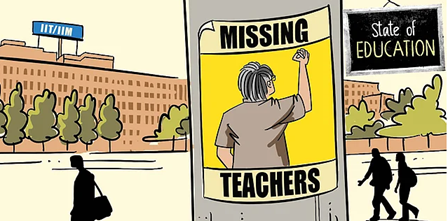
Vacant teaching positions are one of the clearest challenges facing India's higher education sector. A report by SBI Research, published in October 2026, highlighted that approximately 34% of sanctioned teaching posts across centrally funded higher education institutions remained vacant, based on figures cited from parliamentary committee data.
The underlying figures showed that 14,042 of 41,351 sanctioned posts were vacant. Vacancy rates varied across institutions, reaching 54% at Indian Institutes of Information Technology (IIITs) and 39% at central universities. The corresponding rates were 29% at National Institutes of Technology (NITs) and 7% at Indian Institutes of Science Education and Research (IISERs).
These figures illustrate why the total number of teachers alone cannot establish whether institutions have adequate staffing. A university may employ many teachers overall and still have significant gaps in particular departments or senior academic positions.
When faculty shortages persist, existing staff may face heavier teaching loads, leaving less time for research, mentoring and individual student support.
Why Faculty Strength Matters for Learning
Higher education requires more than delivering lectures to large groups. Students need opportunities to discuss concepts, receive feedback, participate in laboratory work and develop research skills under the guidance of qualified faculty members.
In programmes involving practical training, specialised equipment or research projects, adequate staffing is particularly important. A shortage of teachers can limit access to supervision and reduce the time available for individual academic guidance.
Faculty availability also affects institutional research capacity. Teachers balancing heavy workloads may have fewer opportunities to collaborate with industry, publish research or supervise postgraduate students.
The impact, however, depends on several factors, including class sizes, teaching methods, infrastructure and how institutions distribute faculty responsibilities. The national ratio alone cannot establish the quality of teaching at any individual institution.
Recruitment Must Match the Expansion of Higher Education
Addressing the gap requires more than increasing the number of sanctioned posts. Institutions must recruit qualified candidates, reduce delays in appointments and ensure that faculty are distributed according to actual academic requirements.
Regular reviews of department-level vacancies, student enrolment and teaching workloads could help institutions identify shortages before they begin affecting academic delivery. Better reporting that separates public and private institutions, academic disciplines and faculty ranks would also provide a clearer picture of staffing needs.
India's higher education system has made substantial progress in expanding access. The next challenge is ensuring that this expansion is supported by sufficient teaching capacity and strong academic infrastructure.
A national student-teacher ratio can provide a useful starting point, but it should not be treated as a complete measure of institutional health. Ultimately, the quality of higher education will depend on whether students have access to qualified teachers, meaningful academic guidance and the resources needed to learn effectively.