
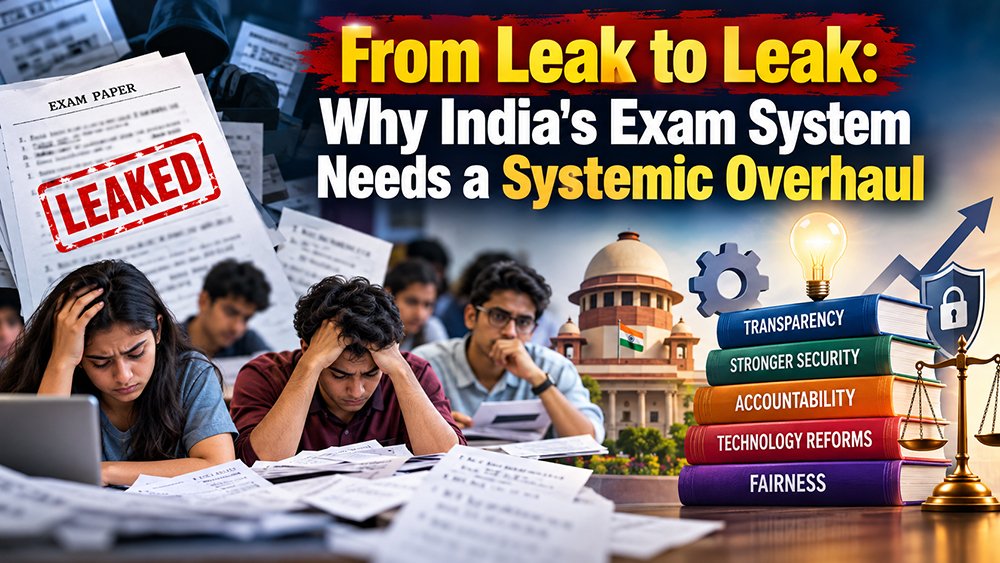
Every few months, India's examination system finds itself back in the headlines for the wrong reasons — a leaked question paper, a cancelled test, lakhs of students left in limbo, waiting for a re-exam date that may or may not come. From NEET to state-level recruitment tests, the pattern has repeated so often that it no longer feels like an isolated failure. It feels systemic.
For years, the standard response to each incident has been the same: tighten security for that specific exam. Add CCTV cameras, deploy more officials, introduce staggered exam timings, or bring in biometric checks at test centres. These measures work, if at all, only for the exam they were designed around. The next test, run by a different board or agency, starts from scratch — with its own vulnerabilities, its own blind spots, and often no institutional memory of what went wrong the last time.
This piecemeal, reactive approach is precisely what critics say India must move beyond if it wants to restore public trust in its examination system.
A Law Alone Isn't Enough
The Public Examinations (Prevention of Unfair Means) Act, passed in 2024, was a meaningful step toward treating exam malpractice as a serious, punishable offence at the national level. It gave law enforcement clearer powers to act against those who leak papers, impersonate candidates, or run organized cheating rackets. But a law, however well-intentioned, does not by itself create the operational backbone needed to prevent leaks before they happen.
What's missing, many argue, is a common Public Examination Integrity Framework — a standardized set of protocols, technology safeguards, and accountability structures that every exam-conducting body would be required to follow, regardless of whether it's the National Testing Agency, a state public service commission, or a railway or banking recruitment board.
What Reform 2.0 Could Look Like
A unified framework would likely rest on a few core pillars. First, secure and decentralized paper-setting and printing processes, so that no single point of failure can compromise an entire exam. Second, end-to-end digital tracking of question papers — from the moment they are created to the moment they reach an exam hall — so that any breach can be traced immediately rather than discovered after the damage is done. Third, independent, periodic audits of examination bodies, conducted by a neutral authority rather than the agency being audited. And fourth, consistent, non-negotiable punishment mechanisms for anyone caught leaking or facilitating cheating, applied uniformly rather than left to the discretion of whichever state or agency happens to be involved.
Equally important — and often overlooked — is the human element. Many past leaks in India have originated not from sophisticated hacking, but from insiders: officials, private printing contractors, or temporary staff exploiting weak internal controls or simple negligence. A robust integrity framework would need to address vetting procedures, access control, and whistleblower protections just as seriously as it addresses technology and encryption. Technology can only close so many gaps; institutional culture and accountability have to close the rest.
Why It Matters Beyond the Headlines
For millions of students across India, competitive exams are not just academic milestones — they are the primary gateway to college seats, government jobs, and social mobility. A single leak doesn't just delay an exam by a few weeks. It forces students to re-prepare, re-sit, and re-live the anxiety of a process they had already been through once. It disproportionately hurts candidates from smaller towns and modest backgrounds, who often cannot afford to keep re-attempting exams the way better-resourced candidates can. Over time, repeated failures of this kind chip away at something harder to rebuild than a cancelled test date: public faith in the fairness of the system itself.
The Real Question
As India's examination ecosystem grows larger, more digitized, and more high-stakes with each passing year, the case for moving from reactive, exam-specific patches to a proactive, nationwide integrity framework is becoming difficult to ignore. Isolated fixes may buy time after each scandal, but they have not — and likely cannot — prevent the next one.
The question India now faces is not whether such reform is needed. Nearly every stakeholder, from students to administrators, seems to agree that it is. The real question is whether there is enough political and administrative will to build a system that doesn't merely react to the last leak, but is structurally designed to prevent it from happening again — across every exam, every state, and every agency, without exception.





