
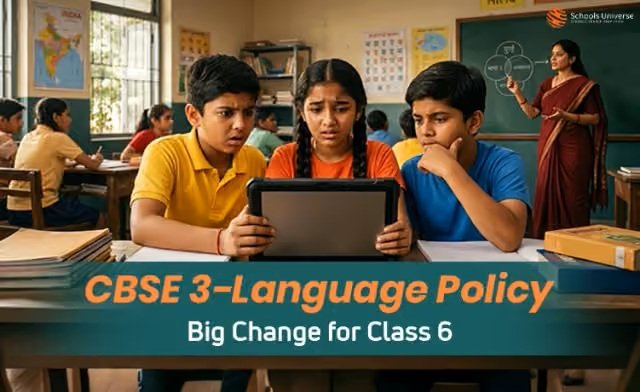
The Supreme Court has directed the Central Board of Secondary Education (CBSE) to extend the transitional exemption under its three-language policy to students currently studying in Class 6. The direction came while the court was hearing petitions challenging the implementation of the language policy, with the bench expressing concern about requiring students to change their language combinations after the academic session had already begun.
The three-judge bench headed by Chief Justice Surya Kant, along with Justices Joymalya Bagchi and V. Mohana, extended to Class 6 the same protection that had already been provided to students in Classes 7, 8 and 9. The court's direction means the current Class 6 batch will not face a separate Class 10 Board examination in the third language under the transitional arrangement.
What the CBSE Three-Language Policy Involves
The CBSE's revised language framework requires students to study three languages, with at least two being native Indian languages. The policy is part of the implementation of the National Education Policy (NEP) 2020 and the National Curriculum Framework for School Education (NCF-SE) 2023.
The changes became a point of contention after CBSE's May 15, 2026 circular introduced the three-language requirement for Classes 6 to 9. Parents and teachers approached the Supreme Court, raising concerns about the timing of the change and the practical difficulties schools and students faced in implementing it during an ongoing academic cycle.
Under the transitional arrangement, students who are already studying two non-native languages can continue with those subjects and add a Bharatiya Bhasha as the third language. The third language remains part of the student's studies, but the current Class 6 students receiving the exemption will not have to take a separate Class 10 Board examination in that language.
Why Class 6 Students Were Given Relief
The central issue before the court was not simply whether students should learn three languages, but how and when the new requirement should be introduced.
The Supreme Court had earlier asked CBSE to consider delaying implementation for the current Class 6 batch. During the September hearings, the bench raised concerns about students having to adjust their language choices after the academic year was already underway and suggested a more gradual or "soft launch" approach.
The concern was particularly relevant for Class 6 students because they had already entered the academic year under an existing language arrangement. Introducing another compulsory subject midway could require schools to find teachers, arrange learning materials and reorganise timetables while students were already following their existing curriculum.
The latest order therefore brings Class 6 students into the same transitional protection already available to the higher classes.
Government Says Schools Are Prepared
The Union government had opposed extending the exemption to the current Class 6 batch, arguing that schools were largely prepared to implement the new system.
During the hearing, the government informed the Supreme Court that around 99% of CBSE schools were ready for the language policy. According to the submission reported during the hearing, only around 1.2% of the board's 28,819 affiliated schools had reported implementation-related issues, while textbooks and supporting material had also been arranged.
The court nevertheless extended the exemption to Class 6, allowing the current batch the same transitional treatment as students in Classes 7, 8 and 9.
The issue now remains before the Supreme Court, with the broader challenges to the implementation of the policy still to be considered.
The Academic Burden Behind the Debate
For schools, introducing a third language involves more than simply adding another subject to the timetable. It requires qualified teachers, textbooks, classroom hours and appropriate assessment mechanisms.
For students, the timing of the change becomes particularly important. Language learning generally develops over several years, and changing the language combination after students have already begun an academic session can create differences in preparation levels within the same classroom.
The petitioners in the case had specifically raised concerns about schools struggling to arrange teachers and books after the policy was introduced. Reports also highlighted concerns among parents about students being asked to adapt to a new requirement after they had already selected their language combinations.
The Supreme Court's intervention therefore focuses on the transition period rather than removing the underlying three-language framework.
Why This Matters
The decision affects a large number of students. The New Indian Express reported that the relief extends to approximately 28 lakh Class 6 students currently covered by the CBSE system.
For these students, the immediate impact is that the third-language requirement will not create the same Board-examination consequence associated with the full implementation of the policy.
The development also highlights a larger issue in education policy: the difference between designing a policy and implementing it inside classrooms.
A curriculum reform may have a clear long-term objective, but its introduction requires schools, teachers, parents and students to have enough time and resources to adjust. The Supreme Court's observations have brought this implementation question into focus.
The Bigger Picture
The three-language policy forms part of the broader changes introduced under NEP 2020, which places greater emphasis on multilingual education and the learning of Indian languages.
The current dispute, however, has centred on the transition to the new framework. The Supreme Court had earlier observed that there was nothing inherently wrong with introducing the policy, while noting concerns about the manner and timing of its implementation.
The debate also reflects the practical complexity of India's multilingual education system. CBSE schools operate across states and regions where students may already speak different mother tongues, study regional languages and use English or Hindi as part of their education.
Implementing a common framework therefore requires flexibility around the languages available in individual schools and the linguistic backgrounds of their students.
What Comes Next
The Supreme Court's latest direction gives the current Class 6 batch the same transitional protection as Classes 7, 8 and 9. The broader petitions challenging the three-language policy, however, remain under consideration.
CBSE and schools will continue preparing for the longer-term implementation of the language framework, while the court is expected to examine the wider issues raised by the petitioners.
The immediate exemption means that current Class 6 students receive additional time to adjust, while the larger question remains how the three-language framework will be implemented across CBSE schools without creating disruption for students already midway through their academic journey.
For India's school system, the episode underlines a recurring challenge in education reform: policy changes may be designed nationally, but their success ultimately depends on how smoothly they reach individual classrooms.





