
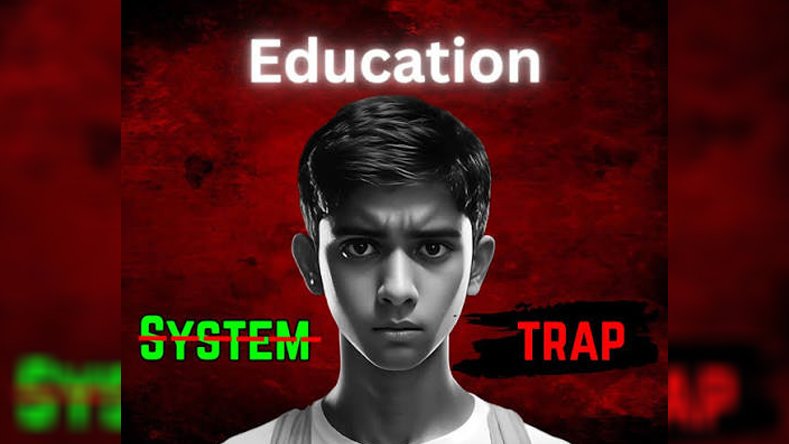
In an analysis published by Hindustan Times, Dr Sharma links the issue to a wider cycle in which declining access to affordable quality education pushes families towards private institutions and additional spending on coaching, while intense competition and concerns around selection and examination systems add further pressure. She argues that education, traditionally seen as one of India's strongest routes to social mobility, risks becoming less accessible to the very groups that depend on it most.
The concern comes at a time when India has one of the world's youngest populations. With a large share of its population below the age of 30, the quality and affordability of education have implications not only for individual careers but also for the country's future workforce.
What Is The ‘Education Trap’?
Dr Sharma uses the term to describe a potential cycle in which high education costs, limited public options, uneven quality and competitive selection systems reinforce one another.
The argument begins with access. Families unable to secure affordable, high-quality public education may turn to private schools, colleges or coaching institutions, increasing their out-of-pocket expenditure. For students competing for a limited number of places in professional institutions, additional coaching and repeated attempts can further increase the financial burden.
According to Dr Sharma, this can eventually create a divide between students who have the financial resources to navigate the system and those whose educational choices are constrained by cost or geography.
Public Education And The Access Question
India's expansion of school education has significantly increased enrolment over the past two decades. The Right to Education framework, introduced through Article 21-A and implemented through the Right of Children to Free and Compulsory Education Act, sought to make elementary education a legal entitlement.
However, Dr Sharma argues that the focus cannot remain on enrolment alone. Learning outcomes, teacher availability, infrastructure and retention are equally important if access is to translate into meaningful educational opportunity.
She points to the decline in the number of government schools over the past decade as an issue requiring attention, particularly for children in rural and disadvantaged communities. Her broader argument is that when public institutions become less accessible or lose their perceived quality, families with the ability to pay increasingly turn towards private alternatives.
The Rising Cost Of Higher Education
The same concern extends into higher education, where professional degrees can involve substantial tuition, living expenses and coaching costs.
India has significantly expanded its university and college network, but the growth has also coincided with greater participation by private institutions. Dr Sharma argues that higher education risks becoming increasingly commercialised when institutions are treated primarily as providers of marketable qualifications rather than as centres of teaching, research and public knowledge.
She also highlights faculty vacancies and financial pressures in public institutions as factors that can affect academic quality. These concerns are particularly relevant as Indian universities seek to expand enrolment while simultaneously improving research and global competitiveness.
Selection And Examination Systems
Another part of the “Education Trap” argument concerns competitive selection.
India's professional education system relies heavily on entrance and qualifying examinations to allocate limited seats.
While competitive examinations are intended to provide merit-based selection, repeated disruptions, delays, examination irregularities or uncertainty can impose additional costs on students who spend months or years preparing.
Dr Sharma argues that the credibility of selection systems is therefore inseparable from educational equity. If students do not have confidence that examinations are conducted fairly and consistently, the burden of preparation can become heavier for those who lack access to expensive coaching and multiple attempts.
Why The Issue Matters
The central concern is not simply that education is becoming more expensive. It is whether cost, quality and access are beginning to reinforce one another in ways that restrict social mobility.
Education has historically been viewed as a pathway through which students from less privileged backgrounds can improve their economic prospects. If affordable public institutions weaken while private education and coaching become increasingly important, that pathway could become more dependent on household income.
Dr Sharma therefore calls for greater attention to public education quality, teacher recruitment, institutional governance and the fairness of competitive selection processes. Her argument is that improving access without maintaining quality—or expanding institutions without ensuring accountability—may not be sufficient.
The Bigger Picture
The “Education Trap” framing raises a broader question for India's education policy: Is the system expanding opportunity at the same pace at which it is creating demand and competition?
India's demographic advantage depends heavily on whether young people can acquire affordable, relevant and high-quality education and skills. The challenge is therefore not only to create more seats, schools or universities, but to ensure that students can realistically reach and benefit from them.
As education costs rise and competition intensifies, maintaining strong public institutions, reliable examinations and accessible pathways into higher education could become increasingly important to preventing educational opportunity from becoming more closely tied to family income.





