
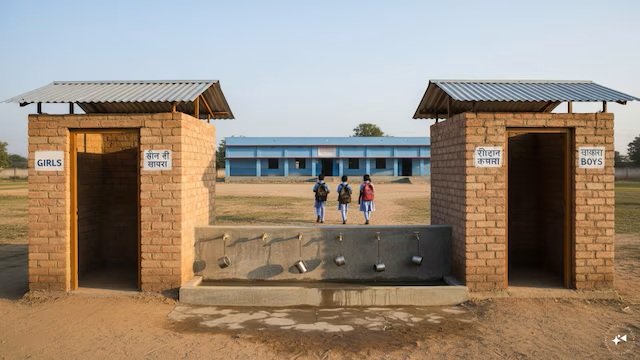
Around 50 million children in India did not have access to sanitation services at their schools in 2025, the highest number reported for any country, according to the WHO-UNICEF Joint Monitoring Programme (JMP) report, Progress on Drinking Water, Sanitation and Hygiene in Schools 2015–2025. The findings highlight that while India has made progress in improving school infrastructure, significant gaps remain in ensuring basic water, sanitation and hygiene (WASH) services for every child.
Globally, 244 million schoolchildren lacked sanitation services in 2025. India was followed by Nigeria, with 34 million children without school sanitation, Ethiopia with 26 million, the Democratic Republic of the Congo with 11 million and Indonesia with 8 million.
India Has Made Progress, But The Gap Remains Large
The report also records improvement in India's school sanitation infrastructure. The number of schools without sanitation services declined by 14% over the period assessed.
The progress is significant in the context of India's efforts to expand sanitation infrastructure. However, the size of the remaining gap means that access to a toilet or other basic sanitation facility cannot yet be considered universal across the country's schools.
For JMP monitoring, a basic sanitation service requires an improved sanitation facility that is usable and provides separate facilities for boys and girls. This makes the measure broader than simply counting whether a school has a toilet. It also considers whether the facility meets basic standards of accessibility and usability.
Drinking Water Access Shows A Different Picture
India's performance on school drinking-water services is comparatively stronger. Around 12 million Indian children lacked drinking-water services at school in 2025, representing roughly one in 20 children globally without such services.
India is among 28 of 62 countries identified as being on track to achieve universal basic drinking-water coverage in schools by 2030. The country's basic drinking-water coverage also increased by more than 4% annually during the period assessed.
However, sanitation is not the only remaining concern. Around 20 million Indian children were estimated to lack hygiene services at school. The JMP noted that insufficient recent data prevented it from producing hygiene coverage estimates for India and the wider Central and Southern Asia region beyond 2024.
Why School WASH Facilities Matter
Sanitation and hygiene are closely connected with children's health and their ability to participate consistently in education. UNICEF notes that safe water and good hygiene help protect children from infectious diseases, while inadequate WASH services can contribute to illness and missed education.
The issue can also have particular implications for adolescent girls. UNICEF India has highlighted the importance of separate toilets and menstrual hygiene facilities in helping girls remain in school and reducing absenteeism.
This makes school sanitation more than an infrastructure issue. The availability, usability and maintenance of facilities can influence attendance, dignity, health and the overall learning environment.
The Global Picture Is Also Off Track
The Indian figures form part of a wider global challenge. The WHO-UNICEF report estimates that the world is not on track to achieve universal access to basic WASH services in schools by 2030.
At the current pace, around 84% of schools are projected to have basic drinking-water services by 2030, compared with 81% for sanitation and 79% for hygiene. Reaching universal coverage would require the current rate of progress to accelerate substantially, including a fivefold increase for basic sanitation.
What Comes Next
For India, the latest findings underline the need to focus not only on building school toilets but also on ensuring that sanitation facilities are functional, usable, gender-sensitive and maintained over time.
The 50 million figure also puts India's progress into perspective. The country has reduced the number of schools without sanitation services, but the remaining gap is still large enough to affect millions of children.
With only a few years remaining before the 2030 Sustainable Development Goal deadline, the challenge will be to convert infrastructure gains into universal, reliable WASH services across schools.





