
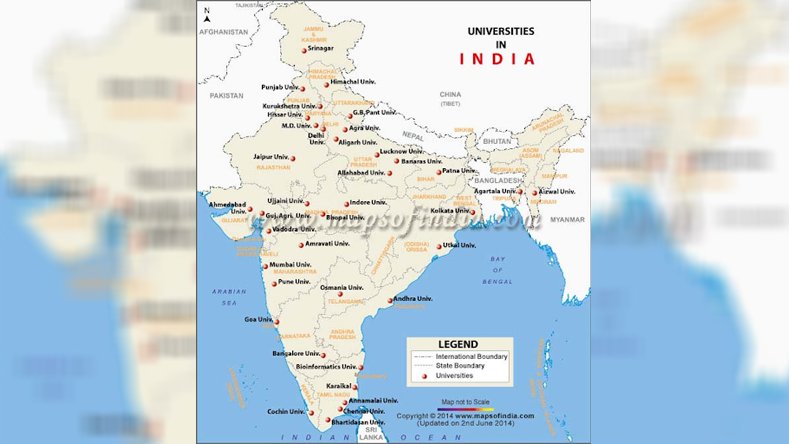
India has added 981 universities and 34,840 colleges since 2001, significantly expanding access to higher education. The number of colleges per lakh people aged 18–23 has increased from nine to 37 during this period, even as the population in the age group grew by 11%.
However, The Geography of Higher Education Report 2026, released by Jetri and Impactica.org, argues that the next challenge is no longer simply expanding the number of institutions. The focus, it says, needs to shift towards where institutions are located and whether their capacity matches the distribution of future students.
Higher Education Capacity Remains Geographically Concentrated
The report highlights a striking concentration of institutions across a small number of districts. Twenty districts account for around 28% of India’s universities, while Bengaluru Urban has the highest number of colleges at 1,225, followed by Jaipur with 809. Overall, 173 districts have at least 100 colleges.
At the state level, seven states — Gujarat, Karnataka, Maharashtra, Madhya Pradesh, Rajasthan, Tamil Nadu and Uttar Pradesh — account for 49% of India’s 1,405 universities and 66% of its 53,433 colleges.
This concentration creates a mismatch between existing higher education capacity and where future demand is expected to grow.
Bihar, UP and Jharkhand Face Capacity Pressure
The report identifies Bihar, Uttar Pradesh and Jharkhand as key states requiring greater higher education capacity.
At current levels, one university in Bihar would correspond to a projected future student population of around 10.3 lakh, compared with approximately six lakh in Uttar Pradesh. The difference highlights the scale of the capacity challenge facing states where the college-age population is expected to remain substantial.
The issue is also reflected in enrolment rates. Assam, Bihar, Jharkhand and Nagaland have a Gross Enrolment Ratio below 20%, compared with the national average of around 30%.
Only Puducherry, Chandigarh, Delhi and Tamil Nadu have crossed the National Education Policy target of 50%, underlining the uneven progress towards expanding participation in higher education.
Regional Access Could Reduce Student Migration
The report also points to the importance of building institutions closer to where students live. Based on Census 2011 data, 83% of education-related migrants remain within their home state, suggesting that regional availability of universities and colleges can play a major role in determining access.
Interestingly, higher education clusters are emerging beyond India’s biggest metropolitan centres. Sikar in Rajasthan has 374 colleges, Azamgarh in Uttar Pradesh has 338 and Belagavi in Karnataka has 317, showing that institutional ecosystems can develop in smaller cities and districts when capacity expands.
At the same time, the system remains highly dependent on state public universities. Around 96% of affiliated colleges are linked to state public universities, while 22 universities each oversee more than 500 affiliated colleges.
India’s Next Higher Education Challenge
The geographic imbalance becomes more significant when viewed alongside international student mobility. Nearly 13.4 lakh Indian students were studying abroad in 2024, almost twice the 2016 figure. In 2022, around 20 Indian students went abroad for every international student studying in India.
The report argues that India’s next phase of higher education expansion should therefore focus on precision rather than simply scale. Instead of developing isolated campuses, it recommends creating interconnected ecosystems of universities, colleges, transport and regional infrastructure.
As Jetri’s Shreyasi Singh noted, the challenge now is identifying where future students will be, where capacity is weakest and where new institutions can have the greatest impact.
For India, the question is increasingly not whether it has built enough higher education institutions, but whether it has built them in the right places.





