
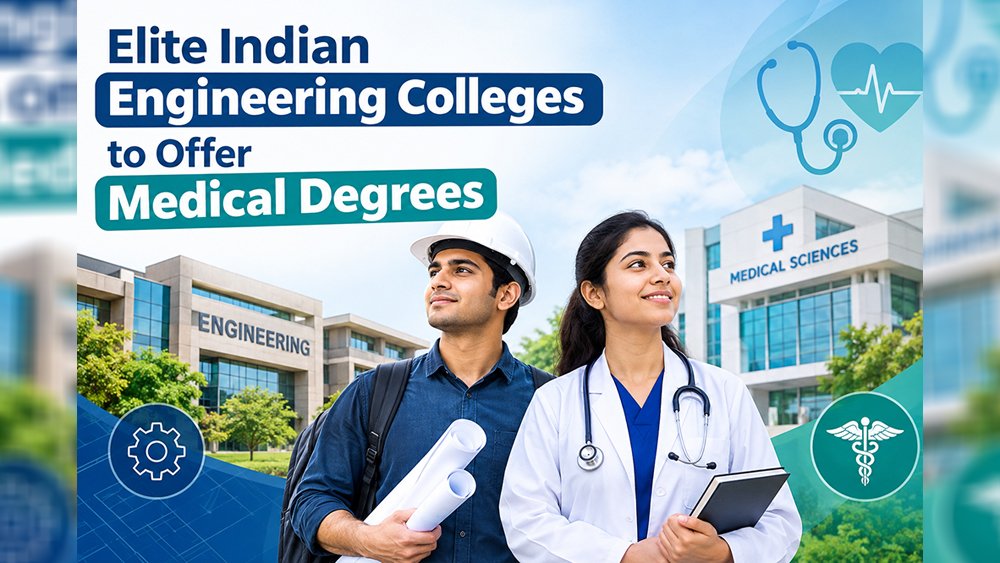
In a move that signals a major shift in how India's premier technical institutions see their future, IIT Madras is reportedly moving into medical education — a space traditionally reserved for dedicated medical colleges and universities. The development comes at a time when artificial intelligence is increasingly being woven into hospital systems, diagnostics, and patient care, prompting some of the country's top engineering institutes to rethink what a "technical education" should include.
Why Engineering Institutes Are Eyeing Medicine
The logic behind this shift isn't entirely new, but it has gained urgency. As AI tools take on a growing role in areas like medical imaging, diagnostics, robotic surgery assistance, and hospital data management, the line between engineering and medicine has started to blur. Institutions like IIT Madras — already strong in computer science, data science, and biomedical engineering — are positioned to argue that training doctors who also understand AI systems, or training engineers who understand clinical environments, could produce a new kind of hybrid professional the healthcare sector increasingly needs.
This isn't just about adding a few courses. Offering full medical degrees would mean IITs stepping into territory governed by an entirely different regulatory and academic ecosystem — one built around clinical training, hospital residencies, and standards set by bodies like the National Medical Commission (NMC), rather than the technical education framework IITs currently operate under.
The Obstacles Ahead
Experts have flagged several challenges that could complicate this ambition. Medical education in India is tightly regulated, with strict requirements around faculty qualifications, hospital infrastructure, clinical training capacity, and accreditation timelines. An engineering institute entering this space would need to build — or partner for — full-fledged hospital and clinical training infrastructure, which is a resource-intensive, multi-year undertaking, not something that can be layered onto an existing technical campus.
There are also questions of institutional identity and faculty expertise. Producing qualified doctors requires clinical faculty, patient-facing training, and a completely different pedagogical approach compared to engineering education. Critics may also question whether stretching into medicine dilutes the core mission and resources of institutions already stretched thin trying to scale their core engineering and technology programs.
Regulatory approval is likely to be another significant hurdle. Any move to offer recognized medical degrees would require sign-off from India's medical education regulators, a process that has historically been slow and cautious, particularly when it involves non-traditional entrants into medical education.
What This Could Mean for Indian Higher Education
If institutions like IIT Madras succeed in offering medical degrees or hybrid medical-technology programs, it could mark a broader trend of India's top technical institutes diversifying beyond pure engineering — following a global pattern where leading universities increasingly blend computer science, AI, and biomedical fields into unified programs.
For now, the ambition reflects a recognition that the future of healthcare will be deeply intertwined with technology — but experts caution that realizing this vision will require far more than curriculum design. It will demand new infrastructure, new regulatory pathways, and a rethinking of what an "engineering institute" is fundamentally built to do.